Chemical Engineering as a Discourse Community
May 11, 2026
Introduction
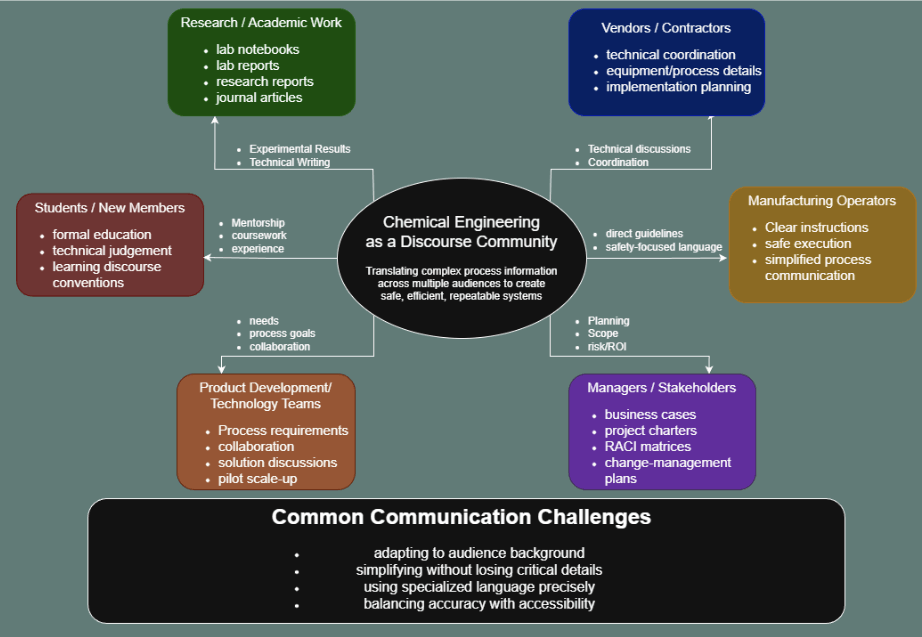
Chemical engineering can be understood as a discourse community because it is more than just a technical field. A discourse community is a group whose members share common goals, specialized language, and recurring ways of communicating with one another. In chemical engineering, these shared practices are especially important because the field depends on translating complex scientific and process knowledge into systems that can be designed, tested, managed, and operated safely in the real world. Engineers in this community do not only solve technical problems. They also have to communicate with different audiences, use specialized documents, and adapt their language depending on context and purpose. As shown in Figure 1, this discourse community is structured around chemical engineers communicating with different audiences through different forms of writing, documentation, and technical explanation.
To better understand how this discourse community functions, our group drew on two interviews that represent different but connected perspectives. One interview was with Professor Lihua Wang, a chemistry professor at Kettering University whose background includes degrees in analytical and inorganic chemistry, extensive research experience, and years of teaching technical concepts to students from multiple disciplines. The second interview was with Craig Schang, the Global Director of Quality and Technology at ChemTrend, whose background is in chemistry and product development and whose professional experience has given him long-term involvement with chemical engineering projects, process design, and manufacturing communication. Together, these interviews show that chemical engineering is a discourse community defined not only by technical knowledge but also by its ability to translate complex process information across multiple audiences to create safe, efficient, and repeatable systems.
Shared Goals and Community Membership
Chemical engineering is held together by a shared goal of designing, improving, and managing processes that transform materials safely, efficiently, and at scale. In Craig Schang’s interview, he described one of the main responsibilities of chemical engineers in his environment as collecting the requirements for specific chemical processes and then designing the equipment and controls needed to manufacture what is required in a repeatable way. This shows that the work of chemical engineers is not limited to understanding chemistry alone. Their role is to apply that knowledge to real systems that must function consistently in practice. In this sense, the community is united not only by technical knowledge but by the shared responsibility of turning chemical principles into processes that can be scaled and controlled reliably.
Membership in this discourse community depends on more than simply holding a degree. It also requires technical knowledge, process understanding, and the ability to work across different phases of development and production. Craig noted that experience is what separates stronger communicators from weaker ones, especially when someone has worked through product development, pilot scale-up, and full production. The experience gives chemical engineers a better understanding of the challenges faced by different stakeholders and helps them communicate more effectively with them.
Professor Wang’s interview adds another dimension to this idea. She emphasizes that work in chemistry requires precision, curiosity, innovation, and strong attention to safety. Those same qualities remain important in chemical engineering, where small mistakes can affect product quality, process performance, or worker safety. Together, these interviews suggest that membership in the chemical engineering discourse community depends on both formal education and the gradual development of practical judgment, technical accuracy, and communication skills.
Communication Across Different Audiences
Chemical engineers do not communicate with only one type of audience. Their work requires them to explain technical processes to people with very different roles, levels of expertise, and priorities. In Craig Schang’s interview, he explained that chemical engineers in his environment communicate most often with vendors, contractors, technology teams, and manufacturing operators. These groups do not all need the same information, which means chemical engineers have to adjust both the level and style of their communication depending on who they are addressing.
According to Craig, communication with vendors and contractors tends to stay more technical, since those conversations are focused on equipment, process details, and coordination. Communication with product development or technology teams is different, leaning more toward what is needed rather than exactly how every part of the process works. Communication with operators must be even more direct and simplified, since operators need clear instructions on what to do in order to carry out processes correctly and safely. This shows that one of the most important communication skills in chemical engineering is knowing how to present the same subject differently to different audiences. Figure 1 reflects this structure by showing that chemical engineers communicate outward to several groups, each of which requires a different level of detail, emphasis, and purpose.
Genres and Professional Documents in Chemical Engineering
Chemical engineering relies on a wide range of written genres, and those documents change depending on the setting, audience, and goal of work. In research-oriented environments, written communication often takes the form of lab notebooks, lab reports, research reports, and journal articles. Professor Lihua Wang explained that she documents experiments and observations in lab notebooks, writes research reports, and works with colleagues to publish journal articles. These documents help preserve results, communicate findings, and share knowledge with others in and outside the field.
In industry, chemical engineering communication extends beyond research writing. In Craig Schang’s interview, he identified project charters, RACI matrices, and change-management plans as especially important in his work environment. These documents help define problems, establish scope and objectives, identify stakeholders, assign responsibility, and manage process changes without creating safety or quality issues. This shows that writing in chemical engineering is not only used to explain technical ideas, but also to coordinate people, guide decision-making, and support implementation. These documents also create accountability, since they help ensure that responsibilities, risks, and process changes are recorded clearly rather than left informal.
Workplace documents from a process-improvement project reflect that same variety. A business case can be used to explain the value, scope, risks, and expected benefits of a project, while a testing procedure gives detailed instructions for carrying out a process safely and consistently. Together, these examples show that chemical engineers rely on very different kinds of writing, from management-facing planning documents to technical instructions used in day-to-day process work. These same document types are shown in Figure 1, where they appear in the communication flow between chemical engineers and the groups they work with.
Specialized Language and Communication Challenges
Like many technical fields, chemical engineering relies on specialized language that enables members of the community to communicate efficiently. Craig Schang noted that the more specialized and technical the language becomes, the greater the chance it will confuse outsiders. This creates a constant tension in the field: chemical engineers need precise terms to discuss processes, equipment, and technical problems accurately, but they also need to know when that same language becomes a barrier to understanding.
One of the main communication challenges in chemical engineering is simplifying complex ideas without removing critical details. Craig explained that conversations must be adapted to the level of the audience, but that important information cannot be lost in the process, especially when those details may affect safety, quality, or execution. He also emphasized that engineers must respect the expertise of other stakeholders rather than assume their own technical background is the only one that matters. This shows that strong communication in chemical engineering requires more than technical knowledge alone. It also requires judgment, humility, and the ability to decide what level of detail a particular audience actually needs.
Professor Wang described a similar strategy from an academic perspective. When communicating with people outside her field, she first considers their background and then uses examples or analogies that are familiar to them. This approach helps make highly technical concepts easier to understand without completely oversimplifying them. Together, these interviews show that language in chemical engineering serves two purposes at once: it allows insiders to communicate with precision, but it also forces them to develop ways of making that knowledge understandable to people outside the field.
How Knowledge and Process Improvements are Developed
In chemical engineering, new knowledge is usually not created in isolation. Craig Schang explained that in his environment, new ideas and process improvements develop through a combination of experiments, collaboration, and documentation rather than from a single source. He noted that completely new processes are actually rare in his industry. More often, chemical engineers work by improving existing systems to increase safety, efficiency, cost-effectiveness, or output. This shows that innovation in chemical engineering often takes the form of refinement and optimization rather than starting from nothing.
Craig also emphasized that these improvements require input from multiple stakeholders. Problems are first identified, then discussions begin about possible solutions, and those ideas are tested through lab work, pilot-scale trials, or equipment demonstrations. This means that knowledge in the chemical engineering discourse community is developed through both technical testing and communication between functional areas. New understanding does not come only from experiments themselves, but also from the discussions, documentation, and decision-making that surround them.
This process connects closely to the writing practices used in the field. Testing documents, reports, and planning materials help record results, compare alternatives, and guide future decisions. In that sense, process improvement in chemical engineering is not only a technical activity, but also a communicative one. Engineers create new knowledge by testing ideas, documenting what happens, and sharing those results in ways that other people in the community can apply. This reinforces the idea that process improvements in chemical engineering become useful only when they can be recorded clearly and communicated to others who may later apply or evaluate them.
Conclusion
Chemical engineering functions as a discourse community because its members share common goals, specialized forms of communication, and a need to adapt technical knowledge for different audiences. The interviews with Professor Wang and Craig Schang provide two useful perspectives on this process, one from the research side and one from industry. Together, they show that success in chemical engineering depends on far more than technical knowledge alone. Engineers and related professionals must be able to document processes, communicate clearly with specialists and non-specialists, and adjust their language without losing critical details. Whether that communication takes the form of lab reports, journal articles, project charters, or testing procedures, it helps make chemical processes safer, more efficient, and more repeatable. In that way, chemical engineering is held together not just by science and engineering principles, but by communication practices that allow those principles to be applied in the real world. Understanding chemical engineering as a discourse community emphasizes the importance of communication in a chemical engineer’s career. They must adapt their language to the audience and situation, as different fields require varying degrees of collaboration among engineers, scientists, managers, and others involved. Ultimately, the ability to translate complex ideas into ones everyone can understand, as well as to develop safe and efficient systems, is what allows chemical engineers to be successful.
